Models are not the bottleneck. Deployment is.模型不是瓶颈,部署才是。
Every company can buy the same frontier models. What separates the few that get value from AI is everything after the model: owners, data, permissions, approvals and sign-offs.每家公司都买得到同样的前沿模型。真正从 AI 拿到价值的少数公司,差别在模型之后的所有事:负责人、数据、权限、审批和签收。
October 7, 2026 · 4 min read2026 年 10 月 7 日 · 阅读约 3 分钟
The model your company can buy today is the same model your competitors can buy. It writes as well for them as it does for you, and it costs them the same per token. Yet when BCG surveyed companies in 2025, only about one in twenty was getting value from AI at scale.
The difference is not the model. It is everything that has to happen after the model: which work it takes on, which data it reads, who is allowed to see what, which actions need a person, and how anyone knows it is working. That is deployment. It is unglamorous, it is specific to each company, and it is where almost all of the value is decided.
We named our company after it. AIDC is an AI Deployment Company.
What a pilot leaves out
A pilot answers one question: can the model do this task? Usually the answer is yes. A capable model can summarise a contract, draft a supplier email or reconcile two spreadsheets in a demo.
What a pilot does not answer is everything a business needs before it relies on that work every day:
- Who owns the result when it is wrong?
- Which version of the numbers is the agent reading, and who decided that?
- Does the agent see salaries, or only the purchasing data the buyer is allowed to see?
- What happens when the agent wants to change a record in the ERP, rather than describe it?
- When the person who set it up leaves, does the know-how leave with them?
None of these are model questions. They are organisational ones. A pilot can skip them. A deployment cannot.
Deployment is five decisions
When we deploy ADIS into a company, the first weeks are spent less on prompts than on five decisions. Each one is written down and signed.
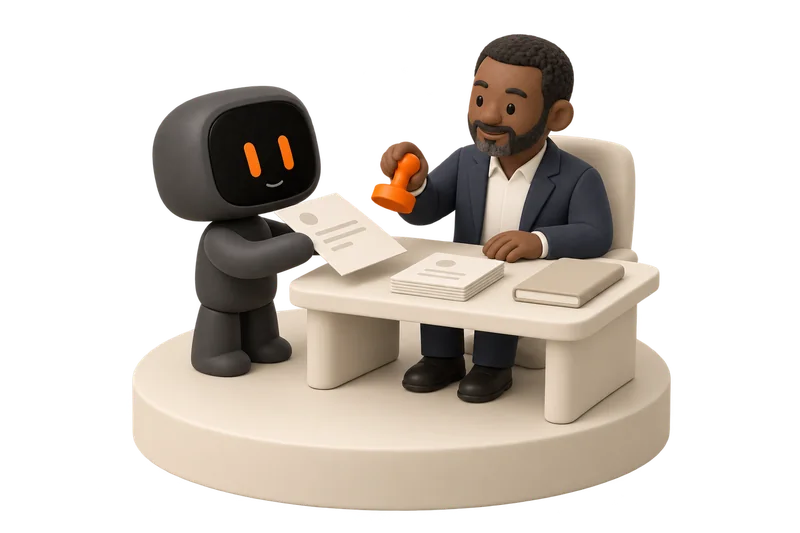
1. Which work, and who owns it. Every department gets one digital employee, and every digital employee has a named owner: the procurement manager for procurement, the finance manager for finance. The owner trains it, corrects it and answers for it. Work without an owner never makes it past the demo.
2. Which data, under one definition. Business systems are connected read-only first. Their records become objects with one shared definition in Semantic, so that "on-time delivery" means the same thing to the agent, the buyer and the board.
3. Who may see what. Permissions follow the organisation chart. A digital employee in procurement sees what the procurement team sees, and nothing more. Sensitive data carries markings that travel with it.
4. Which actions need a person. Reading and drafting are free. Changing a rule, a data model or a record in a business system is a proposal until someone approves it, and every step lands in the Action Log.
5. How progress is signed off. Work runs in two-week cycles. Each cycle ends with a thirty-minute review against criteria agreed in advance, and a set of twenty to fifty real business questions serves as the exam. Anything that falls short moves into the next cycle, visibly.
A platform is a precondition, not a result. Value starts the day real work moves onto it, with a named owner and a signature.
Why we sell systems, not seats
Most AI is sold by the seat or by the token. Both price the tool and leave adoption to the buyer. We price the outcome of each stage instead, because each stage changes something different in the company:
- Agent System, three months. A digital employee in every department, and everyone using it. Signed off by the head of IT.
- Value Chain System, six months. Use cases connected along the value chain, and a team inside the company that can build on its own. Signed off by the business departments.
- Organizational Decision System, twelve months. One set of numbers across the company, and decisions made in the system. Signed off by the chief executive.
Each stage keeps what the previous one built. Departments, roles and data stay in place when you move up.
What a good first month looks like
A good first month is not impressive. It is ordinary in the right way. Everyone in one department has asked their digital employee something real. The owner has corrected it a dozen times, and those corrections are now part of how it works. The exam questions have a score, and the score is going up.
A bad first month is a beautiful demo that nobody uses on Tuesday.
Where to start
We built a platform of nine products because deployment needs one: data and ontology, a runtime for agents, a model foundation, governance and audit. But we never mistake the platform for the work.
Every deployment starts with a two-week assessment: one department, one line of work, and a written plan for what gets built and how it is signed off. If that sounds slower than a pilot, it is. It is also the part that lasts.
你今天能买到的模型,你的竞争对手也能买到。它替他们写的东西,和替你写的一样好;每个 token 的价格,也一样。可是 BCG 在 2025 年的调研里,真正在规模上从 AI 拿到价值的公司,大约只有二十分之一。
差别不在模型。差别在模型之后的所有事:它接哪些活,读哪份数据,谁能看到什么,哪些动作要有人点头,以及怎么判断它真的在起作用。这些事合起来叫部署。它不起眼,每家公司都不一样,而 AI 的价值几乎都在这里定下来。
我们的公司就以它命名:AIDC,AI Deployment Company。
试点漏掉了什么
试点只回答一个问题:模型能不能做这件事?答案通常是能。好的模型在演示里能总结合同、起草给供应商的邮件、核对两张表。
试点不回答的,是业务每天依赖这份工作之前必须先回答的问题:
- 结果错了,谁负责?
- 智能体读的是哪一版数字?谁定的?
- 它能看到工资,还是只能看到采购员本来就能看的采购数据?
- 它想改 ERP 里的一条记录,而不只是描述它,会发生什么?
- 当初搭它的人离职了,经验会不会跟着走?
这些都不是模型问题,是组织问题。试点可以跳过它们,部署跳不过。
部署是五个决定
我们把 ADIS 部署进一家公司,头几周花在提示词上的时间不多,主要花在五个决定上。每个决定都写下来,并且签字。
1. 接哪些活,谁负责。 每个部门一名数字员工,每名数字员工有一位具名的负责人:采购归采购经理,财务归财务经理。负责人训练它、纠正它、为它负责。没有负责人的活,走不出演示。
2. 读哪份数据,按同一个口径。 业务系统先只读接入。记录在 Semantic 里变成对象,用同一份定义。这样「准时交付」对智能体、对采购员、对董事会,意思都一样。
3. 谁能看到什么。 权限跟着组织架构走。采购部的数字员工能看到采购团队能看到的东西,仅此而已。敏感数据带着标记,标记跟着数据走。
4. 哪些动作要有人点头。 查询和起草不受限。改一条规则、一个数据模型、业务系统里的一条记录,在有人批准之前都只是提案;每一步都记进 Action Log。
5. 进度怎么签收。 工作按两周一个交付期推进。每期期末开 30 分钟的评审,按事先约定的标准验收;20 到 50 道真实的业务题就是考卷。没达标的事项公开转入下一期。
平台是前提,不是结果。真正的价值,从真实的工作搬上来的那一天开始:有具名的负责人,有签字。
为什么我们卖系统,不卖席位
大多数 AI 按席位卖,或者按 token 卖。两种都是给工具定价,把「用起来」这件事留给买方。我们按每个阶段的结果定价,因为每个阶段改变的是公司里不同的东西:
- 智能体系统,3 个月。 每个部门一名数字员工,全员用起来。由 IT 负责人签收。
- 价值链系统,6 个月。 场景沿价值链连成系统,公司里有一支自己会建的团队。由业务部门签收。
- 组织决策系统,12 个月。 全公司一本账,在系统里做决定。由一把手签收。
每个阶段都保留上一阶段建好的东西。往上走的时候,部门、岗位和数据都还在原地。
好的第一个月是什么样
好的第一个月并不惊艳,它平常得恰到好处:一个部门里每个人都问过自己的数字员工一件真事;负责人纠正了它十几次,这些纠正已经变成它干活的方式;考卷有了分数,分数在往上走。
不好的第一个月,是一场很漂亮、但周二没人用的演示。
从哪里开始
我们做了九个产品组成的平台,因为部署需要它:数据与本体、智能体的运行时、模型底座、治理与审计。但我们从不把平台当成工作本身。
每次部署都从两周的部署评估开始:一个部门、一条业务线,写清楚要建什么、怎么签收。听起来比试点慢,确实慢一些。但留下来的,是这一部分。
AIDC · AI Deployment CompanyAIDC · AI Deployment Company