Neural Orchestration: Spatio-Temporal Communication for Large-Scale Multi-Agent Systems
September 23, 2026 · Working paper v0.1
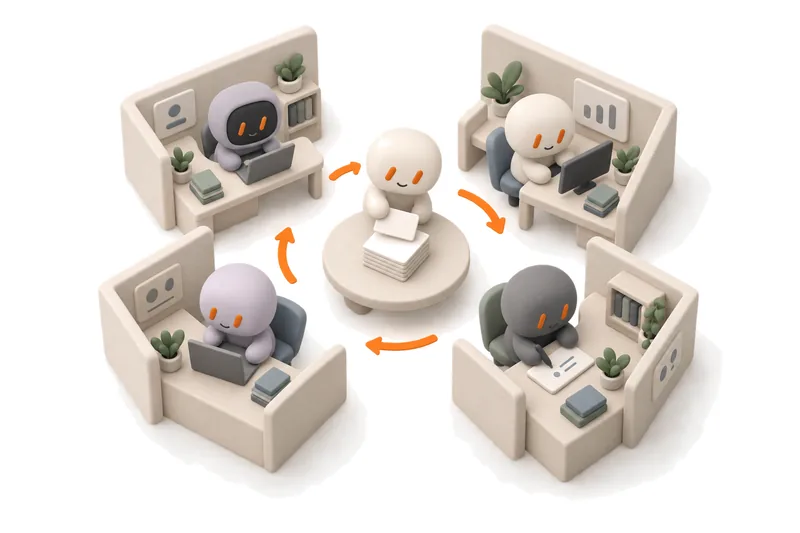
Instead of messaging each other, agents act one at a time in a shared, partitioned task space, and the order of their commits is the channel. Orchestration reduces to typed decisions answered by a small distilled encoder at no token cost.
Abstract
Multi-agent systems built on large language models coordinate through generated messages: a manager writes sub-requests and reads replies, or peers converse, so the cost of orchestration grows with every agent and every reply, and data that one agent may see reaches agents that may not. We propose spatio-temporal communication, in which agents do not message each other at all. A task owns a space partitioned into regions with owners; each domain agent sees only the regions in its access closure; agents act one at a time, and the order of their commits is the channel. Orchestration then reduces to typed decisions, which agent acts next, whether the task is complete, whether the request may proceed, and we answer them with a neural orchestrator: a 421M-parameter encoder trained by distillation from an external decision service, costing one CPU forward pass and no tokens per decision. We formalize the framework, show that orchestration tokens and exposure are bounded by construction, and implement it as an environment-harness layer over an agent-independent distributed harness on which the baseline patterns run with the same agents and the same model. On 80 WorkBench tasks spanning five office systems, the spatiotemporal pattern completes 82.5% of the tasks against 75.0% for a single agent, 52.5% for manager–workers and 68.8% for peer messaging, at half the cost of the manager pattern and with no orchestration tokens; the distilled neural orchestrator reproduces its teacher’s first and policy decisions on held-out templates at 618 ms and no tokens per decision, and we identify the late-step data it still lacks; no agent outside the CRM ever holds the CRM region in its view; and a policy gate refuses 97.2% of probes that ask to move customer data outside the organization or destroy records in bulk, before any agent acts. The same agents run unchanged across nodes and sandbox kinds. The whole study cost under 100 CNY of model usage.
This is a working paper. The full text is in preparation for publication; the abstract above reports its current results.
Cite this work
Yanming Guo (2026). Neural Orchestration: Spatio-Temporal Communication for Large-Scale Multi-Agent Systems. AIDC Research. https://www.ai-dc.ai/research/neural-orchestration
@techreport{guo2026neural,
  title       = {Neural Orchestration: Spatio-Temporal Communication for Large-Scale Multi-Agent Systems},
  author      = {Guo, Yanming},
  institution = {AIDC Research},
  year        = {2026},
  type        = {Working paper},
  url         = {https://www.ai-dc.ai/research/neural-orchestration}
}