Empower human intelligence with machine intelligence: what we mean, and what we don't用机器智能,增强人的智能:我们指的是什么,不是什么
In most companies, capability lives in people and walks out with them. Here is the alternative: people get stronger, experience stays in the organization, and no one is replaced.在大多数公司里,能力存在人身上,人走了能力也跟着走。这篇讲另一种做法:人变得更强,经验留在组织里,没有人被替代。
October 7, 2026 · 4 min read2026 年 10 月 7 日 · 阅读约 3 分钟
In most companies, capability lives in people. The buyer who knows which supplier slips every December. The accountant who knows why one customer's invoices always need a second look. The planner who knows which machine to avoid on a Friday night shift.
That knowledge is real, and it is precious, and it is fragile. It takes months to hire someone and longer to train them. When they leave, their experience leaves with them. And the people who know the most spend their days answering the same questions for everyone else, with little time left for the work only they can do.
"Empower human intelligence with machine intelligence" is how we describe the alternative. It is easy to misread, so here is what we mean by it, and what we don't.
This idea is not new
In 1960, J. C. R. Licklider wrote "Man-Computer Symbiosis", hoping that people and computers would work closely together, each doing what it does best. In 1962, Douglas Engelbart set out the idea of "augmenting human intellect". Neither asked whether a machine could replace a person. They asked how a person could become stronger.
We stand on that line. An organization's strength comes from its people, and no longer only from them: it is human wisdom plus machine intelligence.
A person's day is short. Their experience does not have to stay with one person.
A person's day has a fixed number of hours. If twenty colleagues need the same lead-time check at nine in the morning, the buyer who knows how to do it answers twenty times, or nineteen people wait. Her whole morning goes to one question.
A digital employee that has learned how that check is done can answer all twenty at once, cite the purchase orders it read, and be ready again at 9:05. The buyer no longer has to answer twenty times. Her time goes back to the work that needs her: negotiating the delay with the supplier, deciding which order to rush.
The change is not "one fewer person". It is that her experience reaches more people, and she has time for what matters more.
What we mean
We mean three things.
First, the repetitive work goes to the machine. Lookups, first drafts, follow-ups and weekly summaries are taken on by the digital employee.
Second, judgement, creativity and care stay with people. Approving the quote, deciding on the supplier, signing the month-end report are done by a person.
Third, the way work is done in a company becomes something the company keeps.
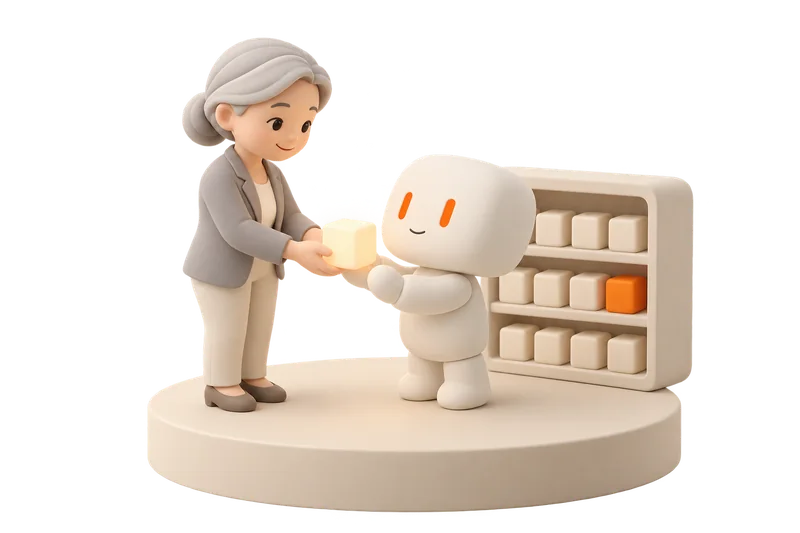
In practice, every department gets one digital employee and every digital employee has a named owner. The owner trains it the way you would train a new colleague: with the policies, the examples, the exceptions, and with corrections. Each correction becomes part of how it works the next day, for everyone in the department. A person's experience does not disappear. It becomes the organization's experience.
What we don't mean
We don't mean replacing people. Our promise is: we empower you, we don't replace you. The digital employee works in the team's chat, next to the team, and it is only as good as the people who train it.
We don't mean "fully automatic". Reading and drafting run freely, but anything that changes a rule, a data model or a record in a business system waits for a person to approve it, and every step is logged. People set the goals, and people make the important decisions.
And we don't mean "set and forget". A digital employee that nobody corrects stops getting better. Ownership is part of the design, not a formality.
Where the technology actually is
A useful way to think about AI capability is the five levels OpenAI has described: chatbots that answer questions, reasoners that analyse problems, agents that get work done, innovators that discover new knowledge, and organisations of AI that run operations together.
Enterprise deployment today is at level three. Agents that take a task in a group chat, read the right systems, draft the result and route it for approval are running every day. Level four is starting to appear at the edges: at customers, digital employees that read the same operating data every day have begun to surface patterns nobody had asked them to look for. Level five is where this is heading, not where it is.
The question for a leadership team is not whom AI will replace. It is how to make every person stronger, where the company's know-how lives, and whether it compounds.
How it compounds
Know-how in people grows slowly and leaves suddenly. Know-how in a system grows with every correction and stays when people move on, so the next colleague starts from higher ground.
That is why a deployment grows in stages. In the first three months, every department has a digital employee and everyone uses it, even if only to ask questions. By month six, the work is modelled role by role and use cases are connected along the value chain; for a growth-stage group, the target is a network of more than a hundred agents. By month twelve, the company works from one set of numbers and makes decisions in the system, and the target is more than a thousand agents across the value chain. The actual scope is set in the deployment assessment.
None of this requires the company to change its systems. The ERP stays. The chat stays. What changes is where the experience lives.
The practical test
If one of your best people left on Friday, how much of what they knew would still be working on Monday? Today, for most companies, the honest answer is very little.
Changing that answer, so that experience stays and every person is stronger than yesterday, is what we mean by empowering human intelligence with machine intelligence.
在大多数公司里,能力存在人身上。那位知道哪家供应商每年十二月都会延期的采购;那位知道某个客户的发票为什么总要多核一遍的会计;那位知道周五夜班哪台机器最好别排的计划员。
这些经验是真的,也很珍贵,但很脆弱。招一个人要几个月,带出来要更久。人一走,经验跟着走。而最懂行的人,每天都在替别人回答同样的问题,没有时间做只有他才能做的事。
「用机器智能,增强人的智能」是我们对另一种做法的说法。这句话容易被读偏,所以这里说清楚:我们指的是什么,不是什么。
这个想法不新
1960 年,J. C. R. Licklider 写了《人机共生》,希望人和计算机紧密合作,各做各擅长的事。1962 年,Douglas Engelbart 提出「增强人类智力」。他们问的不是「机器能不能代替人」,而是「怎样让人变得更强」。
我们站在这条线上。一个组织的能力,来自人,也不只来自人:它是人的智慧,加上机器的智能。
一个人的时间有限,经验不必只留在一个人身上
一个人一天的小时数是固定的。早上九点有二十位同事要核同一批交期,会核的那位采购就得答二十遍,否则十九个人在等。她这一天,被同一个问题占满了。
学会了这件事怎么做的数字员工,可以同时答这二十个人,附上它读过的采购订单,九点零五分又能接下一件。那位采购不必再答二十遍。她的时间回到更需要她的事上:和供应商谈延期,判断哪一张订单要加急。
变化不是「少了一个人」,而是她的经验被更多人用上了,她自己也有时间做更重要的事。
我们指的是什么
我们指的是三件事。
第一,重复的事交给机器。查数、初稿、跟进、周报,由数字员工接手。
第二,判断、创造和对人的关心留给人。批报价、定供应商、签月报,由人来做。
第三,公司里「事情怎么做」,变成公司自己留得住的东西。
具体做法是,每个部门一名数字员工,每名数字员工有一位具名的负责人。负责人像带新同事一样带它:给制度、给例子、讲例外,并且纠正它。每一次纠正,第二天就成了它干活方式的一部分,整个部门都受益。人的经验没有消失,它变成了组织的经验。
我们不是指什么
不是替代人。我们的承诺是:赋能你,而不是替代你。数字员工在团队的群里干活,和团队在一起;带它的人有多好,它就有多好。
不是「全自动」。查询和起草不受限,但凡是要改规则、改数据模型、改业务系统里的记录,都要等人批准,每一步都留痕。目标由人定,重要的事由人拍板。
也不是「装上就不管」。没人纠正的数字员工不会变好。负责人是设计的一部分,不是走过场。
技术真正走到了哪一步
看 AI 的能力,有一个好用的框架:OpenAI 提出的五个等级——回答问题的聊天机器人、分析问题的推理者、把事做完的智能体、发现新知识的创新者,以及一起运营的 AI 组织。
企业部署今天处在第三级。在群里接活、读对的系统、起草结果、提交审批的智能体,每天都在跑。第四级开始在边缘出现:在客户那里,每天读同一份经营数据的数字员工,开始找出没人让它去找的规律。第五级是方向,不是现状。
对管理层来说,问题不是 AI 会取代谁,而是:怎样让每个人更强,公司的经验存在哪里,会不会越积越多。
怎样越积越多
存在人身上的经验,长得慢,走得快。存在系统里的经验,每纠正一次长一点,人走了也还在,下一位同事一上来就站得更高。
所以部署按阶段长。前 3 个月,每个部门都有数字员工,全员在用——哪怕只是问答。到第 6 个月,按岗位把活建模,场景沿价值链连起来;对一家成长期的集团,目标是一张 100 个以上智能体的网络。到第 12 个月,全公司一本账、在系统里做决定,目标是覆盖价值链的 1000 个以上智能体。具体范围在部署评估里定。
这些都不需要公司换系统。ERP 还在,群聊还在。变的是经验存放的地方。
一个实际的检验
如果你最好的员工周五离职,这个人知道的东西,到周一还有多少在继续起作用?对今天的大多数公司,诚实的答案是:很少。
让这个答案改变,让经验留下来、让每个人都比昨天更强,就是我们说的:用机器智能,增强人的智能。
AIDC · AI Deployment CompanyAIDC · AI Deployment Company