Why one company can take on its whole supply chain为什么一家企业能整合上下游
A supply chain is long because coordination is expensive. Coase showed that this cost sets the boundary of the firm. AI cuts it, inside companies and between them.供应链长,是因为协调贵。科斯说明了,正是这个成本决定企业的边界。AI 正在把它降下来,在企业内部,也在企业之间。
October 25, 2026 · 7 min read2026 年 10 月 25 日 · 阅读约 4 分钟
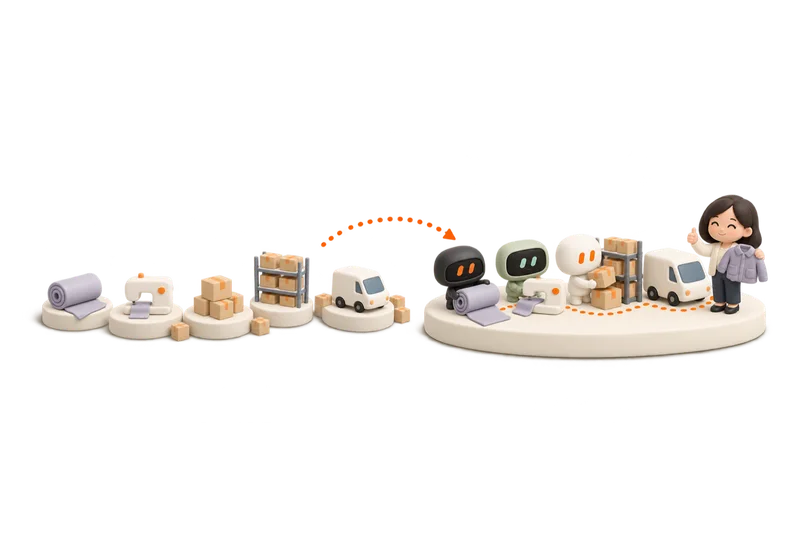
Make a jacket today and the work passes through a dozen companies: a brand plans it, a designer draws it, a mill weaves the fabric, a sample room cuts a sample, a factory sews it, a wholesaler stocks it, a retailer sells it and a carrier delivers it. Between most of those steps sits a buffer: a safety stock, a warehouse, a markup. From idea to your hands often takes months.
None of this is an accident, and none of it is stupid. Each company and each buffer is there because coordinating the next step is expensive. That cost is what decides how big a company can be. AI is about to change it.
Why firms have edges at all
In 1937 a young economist, Ronald Coase, asked a question that sounds naive: if markets are so efficient, why do firms exist? Why doesn't everyone just buy each step from whoever offers the best price?
His answer, in The Nature of the Firm, was that using the market has a cost. You have to find a supplier, compare prices, negotiate, write a contract and check that it was kept. A firm avoids those costs by giving instructions instead of signing contracts. But organizing inside a firm has a cost too, and that cost grows as the firm gets bigger: more layers, more meetings, more information passed from person to person, more mistakes in the passing.
So a firm grows until one more step costs as much to organize inside as it would to buy outside. That point is the boundary of the firm. Oliver Williamson later built transaction cost economics on this idea, and both men received the Nobel Prize for it.
The supply chain is a map of coordination costs
Seen this way, a long supply chain is a map of where coordination got too expensive. Each handoff between companies is a place where one firm stopped, because the next step was cheaper to buy than to manage.
The buffers tell the same story. Each layer forecasts demand again from the orders it receives, and the errors grow from layer to layer. Jay Forrester described this in the 1960s, and it has been called the bullwhip effect since the late 1990s. Safety stock, extra warehouses and middlemen are the price of not knowing, in time, what the next layer needs.
In short: the chain is long because coordination is scarce.
What AI changes: two forces
AI does not change the logic of the boundary. It changes the two costs that set it.
The first force: coordinating inside gets much cheaper. Much of the internal cost of a firm is information work: collecting numbers, passing them up, turning instructions into tasks, checking that tasks were done. This is the work of the middle of the organization, and it is exactly what agents do well. When digital employees read one shared definition of the business, run the routine steps around the clock and record every action, one more step inside the company no longer costs one more layer of people and meetings. The internal cost curve flattens, the boundary moves out (point 2), and a company that uses AI well can take on work that used to span several companies up and down its supply chain.
The second force: trading between companies gets cheaper too. Agents can also find a supplier, ask for a quote, place an order inside agreed rules and reconcile the invoice. When both sides of a trade run on systems like this, buying from outside becomes nearly as cheap as calling a function. The market line drops, and the boundary moves partly back (point 3).
Both forces act at the same time. That is why we expect two kinds of companies to grow together: much larger firms that run whole chains, and many small firms that sell one excellent capability to everyone through their agents. Zeng Ming, in his book Intelligence, describes supply chains turning from fixed chains into networks that form around each task. Kevin Kelly has made a similar prediction for companies: both much larger ones and many more one- and two-person ones.
The supply chain is long because coordination is scarce. Make coordination cheap, and the chain gets short.
What does not change
Transaction costs are not only about information. Williamson also pointed to specific assets, like a machine built for one customer, and to the risk that a partner behaves badly. AI lowers the cost of knowing and of agreeing; it does not remove the need for trust, for capital or for someone who answers for the result. Factories, trucks and materials still obey physics. And in every company we work with, people still set the goals, approve the exceptions and answer for the outcome. The boundary moves; responsibility does not.
What this means for a company today
You do not need to wait for the long-term picture to act on it. Three steps follow directly from the argument:
- Find where you pay for coordination. List the handoffs, reconciliations, buffers and status meetings in one line of work, like order to cash or purchase to pay. Each one is a coordination cost.
- Give those steps one definition. Put the orders, materials, schedules and invoices into one shared model of the business, so that every person and every agent reads the same numbers.
- Let agents run one full loop inside the company first. Once a loop runs end to end, with people approving the exceptions, connect it to your suppliers and customers.
That is the order in which we build AIDC: first we run the business inside each company, then we connect companies to each other. Our vision describes where that leads: in ten years, superintelligence runs the world's production, and the chain from an idea to a product gets short.
今天做一件外套,要经过十几家公司:品牌做企划,设计师画图,面料厂织布,打样间做样衣,工厂缝制,批发商备货,零售商卖出,物流公司送达。大多数环节之间还隔着一层缓冲:安全库存、仓库、加价。从一个想法到你手里,常常要几个月。
这些都不是偶然,也不是谁笨。每一家公司、每一层缓冲之所以在那里,是因为协调下一步很贵。正是这个成本,决定了一家企业能做多大。AI 正要改变它。
企业为什么有边界
1937 年,年轻的经济学家罗纳德·科斯(Ronald Coase)问了一个听起来很天真的问题:既然市场这么有效率,为什么还要有企业?为什么不是每一步都向出价最好的人去买?
他在《企业的性质》(The Nature of the Firm)里的回答是:用市场是有成本的。你要找供应商、比价、谈判、签合同、检查对方有没有履约。企业用下指令代替签合同,省掉这些成本。但在企业内部组织也有成本,而且企业越大,这个成本涨得越快:层级更多、会更多、信息在人与人之间传得更多、传错的也更多。
所以,企业会一直长大,直到多做一个环节的内部组织成本,和向外面买的成本一样高。那个点,就是企业的边界。后来奥利弗·威廉姆森(Oliver Williamson)在这个思想上建立了交易成本经济学,两人都因此获得了诺贝尔经济学奖。
供应链,是一张协调成本的地图
这样看,一条长长的供应链,就是一张「协调在哪里变得太贵」的地图。企业之间的每一次交接,都是一家企业停下来的地方:下一步向外买,比自己管更便宜。
缓冲讲的是同一件事。每一层都根据自己收到的订单重新预测需求,误差一层一层放大。杰伊·福雷斯特(Jay Forrester)在 1960 年代描述过这个现象,1990 年代末起它被叫作「牛鞭效应」。安全库存、多出来的仓库和中间商,都是「没能及时知道下一层要什么」的代价。
一句话:链条长,是因为协调稀缺。
AI 改变了什么:两股力
AI 不改变边界的逻辑,它改变决定边界的两个成本。
第一股力:企业内部的协调便宜得多。 企业内部的成本,很大一部分是信息工作:收数、往上报、把指令拆成任务、检查任务做没做完。这是组织中间层的工作,也恰恰是智能体擅长的。当数字员工读同一份业务定义、全天跑例行的环节、每一步都留下记录,企业多做一个环节,就不再意味着多一层人、多一轮会。内部成本曲线变平,边界往外移(第 2 点):一家用好 AI 的企业,能接下过去分散在上下游几家公司的业务。
第二股力:企业之间的交易也变便宜。 智能体也能找供应商、询价、在约定的规则内下单、核对发票。当交易双方都运转在这样的系统上,向外买几乎和调用一个接口一样便宜。市场的那条线下降,边界又往回移一部分(第 3 点)。
两股力同时起作用。所以我们预计,两类企业会一起长大:运转整条链的大企业,以及通过智能体把一项出色能力卖给所有人的小企业。曾鸣在《智能》里说,供应链会从固定的「链」变成按任务临时组成的协同网络;凯文·凯利(Kevin Kelly)也预测,未来既会有大得多的企业,也会有多得多的一两人公司。
链条长,是因为协调稀缺。让协调变便宜,链条就会变短。
什么不会变
交易成本不只是信息成本。威廉姆森还指出了专用资产(例如只为一个客户造的设备)和合作方失信的风险。AI 降低的是「知道」和「谈拢」的成本,它不能取代信任、资本,也不能取代对结果负责的人。工厂、卡车和原料仍然受物理规律约束。在我们合作的每一家企业里,目标仍然由人来定,例外仍然由人来批,结果仍然由人负责。边界会移动,责任不会。
对今天的企业意味着什么
不用等远景实现,今天就可以照这个道理做三件事:
- 找出你在哪里为协调付钱。 选一条业务线,例如从订单到回款、从采购到付款,列出其中的交接、对账、缓冲和进度会。每一项都是协调成本。
- 给这些环节一份共同的定义。 把订单、物料、排产和发票放进同一个业务模型,让每个人、每个智能体读的是同一份数。
- 先让智能体在企业内部跑通一个完整的闭环。 闭环端到端跑起来、例外由人批准之后,再把它连到你的供应商和客户。
这也是我们建 AIDC 的顺序:先运转每一家企业内部的业务,再把企业之间连起来。我们的愿景写了它通向哪里:十年后,超级智能运转全社会的生产,从一个想法到一件产品的链条会变短。
AIDC · AI Deployment CompanyAIDC · AI Deployment Company